
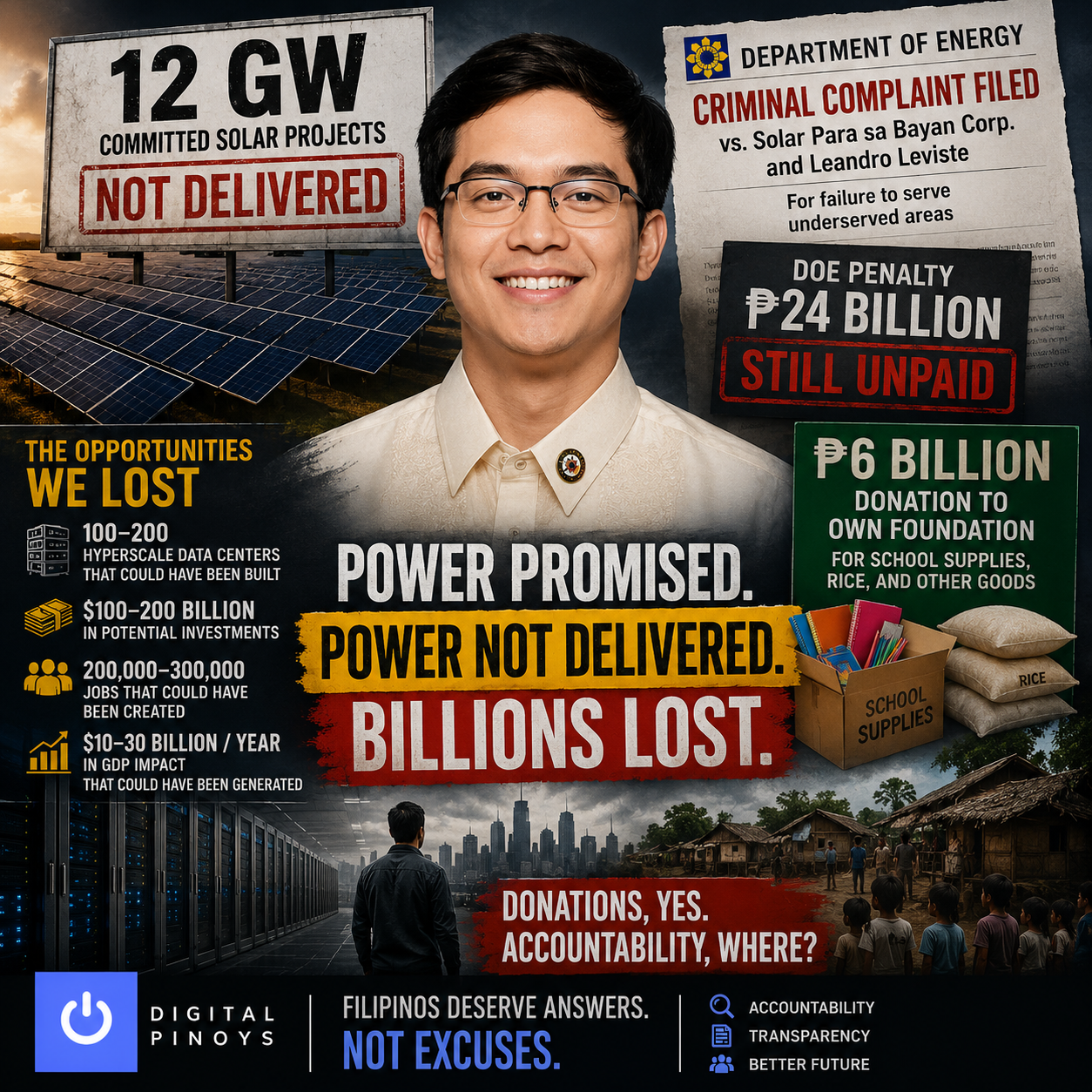
Digital advocacy group Digital Pinoys welcomed today the filing of a criminal complaint by the Department of Energy (DOE) against Batangas 1st District Rep. Leandro Leviste-owned Solar Para sa Bayan, calling it a long-overdue step toward accountability following years of non-delivery of committed energy projects.
Digital Pinoys national campaigner Ronald Gustilo said the case highlights a deeper national issue: the massive economic opportunities lost due to undelivered power capacity.
“This is not just about a legal case. This is about years of missed opportunities for the Philippines. While communities remained unserved, the country also experienced a massive setback after it missed the opportunity to build the infrastructure needed for a modern digital economy.”
The DOE filed the complaint before the Department of Justice over the firm’s alleged failure to deliver electricity services to underserved communities despite holding a congressional franchise, noting that the company failed to operationalize its mandate years after it was granted.
Gustilo emphasized that the failure to deliver large-scale power projects had far-reaching consequences beyond electrification gaps.
“That level of undelivered power could have supported over a hundred hyperscale data centers and attracted more than USD 100 billion in investments. Instead, those investments went to neighboring countries where power commitments were actually fulfilled.”
Aside from energy supply stability, Gustilo added that the country likely lost hundreds of thousands of potential jobs, billions of dollars in annual economic activity, and the opportunity to be in a strategic position as a regional hub for cloud and AI infrastructure.
Gustilo also stressed that the DOE complaint, centered on failure to serve off-grid communities, also reflects a broader pattern of non-performance in critical infrastructure delivery.
“When power projects fail to materialize, the consequences are not isolated. We fail to electrify communities, and at the same time, we fail to attract high-value industries that depend on reliable power.”
Gustilo underscored that the issue is no longer just about compliance but about national competitiveness and credibility.
“This is a defining moment. The Philippines cannot afford to ignore and normalize large-scale non-delivery in critical infrastructure. The cost is simply too high economically, socially, and strategically.”


The economic impact of undelivered power is striking, and this case really underscores that. Beyond legal accountability, it’s worth exploring how future energy projects can be structured to ensure commitments are actually fulfilled, so communities and investors don’t continue to lose out.
This is a critical reminder of how regulatory failures directly impact our digital economy, as the missed power capacity could have anchored hundreds of billions in investment. It is frustrating that while our communities remain underserved, neighboring nations are capitalizing on these energy gaps. Accountability is long overdue to ensure we stop losing these opportunities for modernization.