Submitted to the Senate Committee on Games and Amusement
Introduction
Digital Pinoys submits this paper on behalf of Filipino consumers, who are the most affected by the spread of online gambling. Every day, ordinary citizens are bombarded with illegal gambling ads on social media, tricked by copycat websites, and lured into illegal platforms that operate without rules, safeguards, or accountability.
Consumers are not asking for a ban on all online gambling. What we demand is protection — protection from predatory operators, protection from misleading advertisements, and protection from a system that currently allows illegal actors to thrive.
Consumer Experience in the Current Landscape
1. Vulnerability to Deception
o Many consumers cannot tell the difference between a licensed site and an illegal one because of deliberate imitation of branding and URLs.
o Once inside these illegal platforms, players are left with no recourse if they are cheated or defrauded.
2. Exposure to Financial and Social Harm
o Families have lost savings to gambling debts facilitated by unregulated operators.
o Minors and young adults, heavily exposed to digital ads, are drawn into gambling at an early age. These ads are usually done through social media influencers promoting illegal gambling sites.
o Unlike licensed operators, illegal sites do not provide self-exclusion programs or tools for responsible gambling.
3. Lack of Consumer Voice
o Consumers are hesitant to report, despite the government’s efforts to inform the public. Most of the public see filing a complaint as burdensome and they feel like it will not be acted upon.
o This silence has allowed illegal gambling to grow unchecked, while ordinary Filipinos carry the burden of its consequences.
Digital Pinoys’ Consumer-Centered Interventions
As advocates of digital consumer rights, Digital Pinoys has taken steps to give citizens a voice and a measure of protection:
1. Illegal Online Gambling Reporting Site
o A platform where consumers themselves can report suspicious websites, social media endorsers, and gambling ads.
o Reports are verified against PAGCOR’s list of licensed operators to ensure fairness and accuracy.
2. Consumer Protection Through Technology
o Digital Pinoys has developed a program that blocks access to verified illegal gambling sites.
o This program will soon be turned over to the Cybercrime Investigation and Coordinating Center (CICC) and the Department of Information and Communications Technology (DICT) to give consumers immediate protection at the digital level.
3. Partnership with government agencies
o Digital Pinoys has partnered with the Cybercrime Investigation and Coordinating Center and the Department of information and Communications Technology to strengthen the campaign, not just against illegal gambling, but also other forms of cybercrime.
Policy Recommendations from the Consumer’s Perspective
To truly protect Filipinos, the regulatory framework must be reoriented around the rights and welfare of consumers:
1. Stricter Penalties for Exploitation
o Illegal operators and their endorsers must be held fully accountable, with penalties proportionate to the harm inflicted on Filipino families.
2. Accessible Blocking and Takedown Mechanisms
o ISPs and telcos should be mandated to block illegal sites once validated, preventing consumer access before harm occurs.
3. Consumer Empowerment and Education
o Launch nationwide campaigns to educate the public on the risks of illegal gambling.
o Equip consumers — especially youth and low-income families — with the digital literacy tools to resist deceptive ads and fraudulent sites.
4. Stricter Know your client protocol
o Submission of a valid identification card which will can be verfied by an artificial intelligence software. Gamblers will only be allowed to access games once the identity os verified. As such, the need for an identity verification for each and every login should be implemented.
5. Automatic cooldown period for every milestone loss
o A progressive involuntary cooldown period for every milestone loss should be in place. For example, once a gambler loses P10,000.00, he will be automatically logged out of the system for a fixed period of time. The next time that particular player loses again, another cooldown period will be imposed against the gambler, only this time this will be longer than the first cooldown period.
1 account per person per site
o Gamblers should only be allowed to have one account for each platform.
Conclusion
From the perspective of Filipino consumers, the online gambling problem is not just about lost government revenue — it is about lost savings, broken families, and eroded trust in the digital economy.
Consumers demand stronger safeguards, faster enforcement, and real accountability. We are asking this Senate Committee to prioritize our welfare by strengthening regulatory reforms and decisively curbing illegal online gambling. But let us be clear, the stronger focus of the government and the overall campaign regarding online gambling should be on the eradication of illegal online gambling. This is where the real battle is. All the violations, including the granting of access to underage gamblers, predatory gambling mechanisms such as small-amount betting can be attributed to the illegal operations. They are the real menace and all efforts must be done to stop them.
Digital Pinoys stands with the Filipino people in this call. Through our reporting platform and our blocking program, we are giving consumers both a voice and a shield. But lasting protection will only come with bold reforms and the political will to enforce them.
Respectfully submitted,
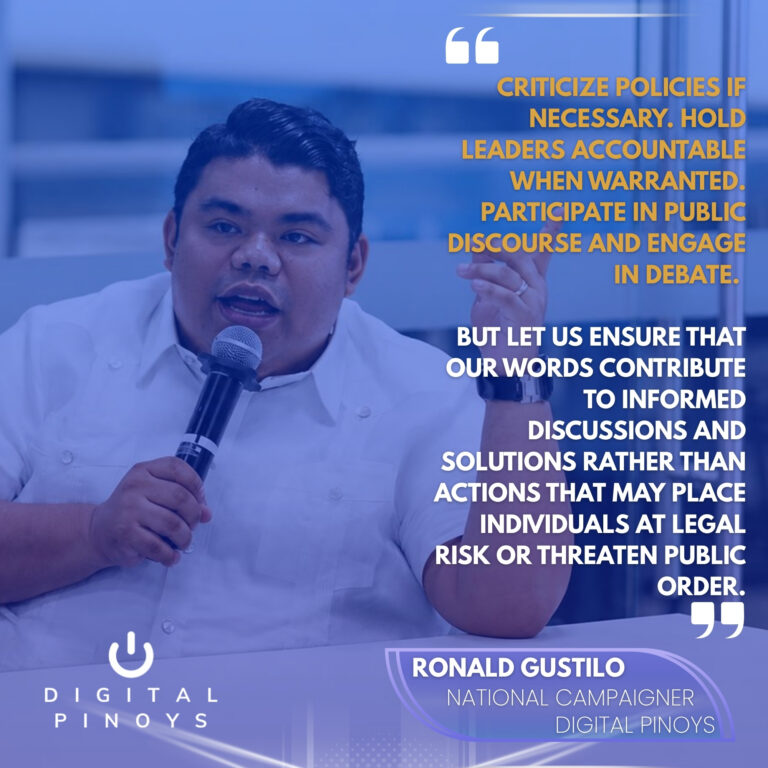
Ronald Gustilo
National Campaigner
Digital Pinoys